
India's defence expenditure surged to $92.1 billion in 2025, making it the world's fifth-largest military spender, according to SIPRI data. This 8.9 per cent year-on-year rise was primarily driven by operational and procurement needs following heightened regional tensions with Pakistan in May 2025.

'We were in a heavily nuclearised environment. China had tested for Pakistan in the 1980s and helped their missile programme stay just one step behind us.'

In a testimony before the Senate Intelligence Committee, Gabbard, the Director of National Intelligence, also said that the threats to the US were set to expand collectively from more than 3,000 missiles at present to more than 16,000 missiles by 2035.
A US federal government commission has raised concerns about the state of religious freedom in India, recommending its designation as a 'Country of Particular Concern' and suggesting targeted sanctions.
In its annual report to Congress on Tuesday on 'Military and Security Developments Involving the People's Republic of China 2025', the US Department of War said the People's Liberation Army (PLA) is actively considering and planning for additional military facilities.
'Some success has been achieved in raising the costs of terrorism for Pakistan.'

The delegations from the US and Iran head to Islamabad on Friday, carrying a ceasefire that is already fraying, a Strait that is technically open and practically closed, and a negotiating agenda that would challenge even parties actually negotiating in good faith, which these groups are not. Prem Panicker continues his must read blog on the Iran War.

'The next two to three weeks will not be decided in Washington.' 'They will be decided in Tehran, in whatever calculation Iran makes about the costs of continued resistance against the costs of appearing to have yielded.'

The question is no longer whether the war will expand. It has. The next few days will tell us whether the war stabilises around Hormuz or whether the Strait itself becomes the trigger for a far larger rupture. What to watch for over the next 48 hours is simple: Any move by the US toward direct naval control of the Strait; any credible Iranian attempt to disrupt or mine shipping lanes and, critically, whether energy infrastructure in the Gulf continues to be targeted.If those lines are crossed in tandem, the war will no longer be containable within the region.

The United States, which entered this war in expectation of a short, sharp win along the Venezuela model, is now preparing for deeper involvement in a conflict it does not fully control, without the allies it typically relies on, against an adversary that is not behaving as expected, in a global environment that is already absorbing economic shock. Prem Panicker continues his must read daily blog on the Gulf War.
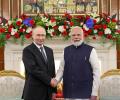
Luckily for us, a Russia that is desperate to stay relevant in an emerging multipolar world finds in India a reliable geostrategic partner. The Russian proximity to India also keeps China from exploiting its economic dominance vis a vis Russia, points out Colonel Anil A Athale (retd).
Records stretching back to 1947 suggest a consistent strategy by Pakistan's military and intelligence apparatus, the Inter Services Intelligence (ISI), of using terrorism as a state policy against India.

'After the Galwan clash, the rules of engagement changed with the army commanders allowed to use any means at their disposal as they deem fit for tactical operations.'
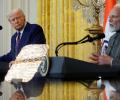
India and the US have entered a new phase in their relationship, marked by greater parity, point out Harsh V Pant and Vivek Mishra.

US lawmakers have expressed concerns that policies enacted by the Trump administration, such as the H1B visa fee and tariffs on India, are detrimental to American businesses and threaten the relationship between the United States and India.

This is the most open T20 World Cup in history. The traditional powers are compromised. The new powers have gained strength, observes Faisal Shariff.

In 2025-26, the government allocated Rs 6,81,210 crore for defence budget.

Around 100 artistes heralded the parade, on the theme 'Vividata Mein Ekta (Unity in Diversity) that featured a grand presentation of musical instruments, demonstrating the nation's unity and rich cultural diversity.

India emerged from the war militarily bruised and strategically altered. The United States, under the guise of friendship, had succeeded in achieving what open alignment never could: The psychological and political repositioning of India within the Cold War order, points out Dr Kumar.
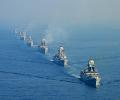
A parliamentary panel on external affairs has expressed concern over China's growing presence and influence in the Indian Ocean Region, citing risks to India's national security and strategic interests. The panel also highlighted the strengthening China-Pakistan naval nexus as a cause for concern.
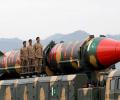
After Donald Trump became president of the United States, he unleashed economic weaponisation, upsetting the old world order, leading to much unrest. If that wasn't all, the threat of an imminent nuclear war was issued by the US, Russia, China, North Korea and Pakistan. In today's fractious times, Dr Paulos Mar Gregorios would have made a dent, notes His Holiness Baselios Marthoma Mathews III.

Dhurandhar's most dangerous idea is that Director Aditya Dhar envisions an Indian state run by a deep state -- an intelligence machinery not accountable to Parliament, courts, or voters. A future political system where unelected officials decide when Indian democracy is 'fit' to function, observes Syed Firdaus Ashraf.

We have nothing to gain by raising our concerns internationally as our narrative has got entangled with several controversial concepts in the United Nations, asserts Ambassador T N Sreenivasan.
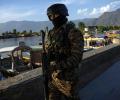
The 'mediation' by the United States from behind the scene on the diplomatic track appears to be once again working, which calls on both Delhi and Islamabad to show restraint and pull back from a military confrontation, notes Ambassador M K Bhadrakumar.
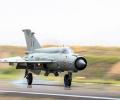
The MiG-21 episode demonstrates that procurement is always strategic.
Choices about what aircraft to acquire, who builds them, who supplies the spares, who trains the pilots and technicians are decisions with political consequences lasting for decades.
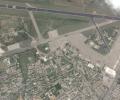
India's strikes on Pakistan damaged runways and structures across at least six airfields, according to a visual analysis by The Washington Post, which experts said were the most significant attacks of their kind in decades of simmering conflict between the two nations.
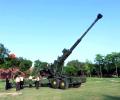
The Indian government outlines its futuristic defence programme, Sudarshan Chakra Mission, focusing on indigenous development, predictive technologies, and targeted counter-action systems to enhance national security.
The Border Security Force (BSF) is raising a maiden 'drone squadron' for deployment along the India-Pakistan border. The squadron will comprise reconnaissance, surveillance and attack drones and specially-trained personnel.
'Right now, we have no relationship with Pakistan. And the relationship with China is not great.'

The defence minister also announced that India has taken up the challenge of developing a powerful indigenous aero-engine, adding that preparations for this critical project are now almost complete and the work will soon be visible.
As India and China continue to face off across the Himalayas six decades later, the echoes of that earlier conflict remain unmistakable. The core of China's sensitivity lies not in maps or mountain passes, but in its perception of sovereignty over Tibet, points out Dr Kumar.

Nearly all of the nine nuclear-armed States, including India and Pakistan, continued intensive nuclear modernisation programmes in 2024, upgrading existing weapons and adding newer versions, according to a report by a global think-tank.
'It showed me that this man had courage. He makes his own decisions, but he also trusted me enough in that moment to walk with me into the crowd,' Modi tells Lex Fridman on his podcast.

Union Home Minister Amit Shah has announced that India will soon create a comprehensive anti-drone unit to secure its borders. He highlighted the increasing threat posed by drones, especially along the India-Pakistan border, and emphasized a 'whole of government' approach to tackle this issue. Shah also spoke about the ongoing Comprehensive Integrated Border Management System (CIBMS) and the Modi government's Vibrant Village Programme, which aims to develop and integrate the population of northern borders.

'The ruling elite are supporting those attacking the people of Gaza.' 'As a nation we should not cooperate with the oppressor regime that is allowing mass starvation as a weapon of war.'

'Geopolitically and diplomatically it's a very difficult situation for India.'

The move came against the backdrop of Turkiye backing Pakistan and its condemnation of India's strikes on terror camps in the neighbouring country and Pakistan-occupied Kashmir under Operation Sindoor.

By threatening to punish India with high tariff, Trump is actually planting a tantalising thought in the Indian mind that the Modi government should suitably 'incentivise' him, explains Ambassador M K Bhadrakumar.

JD-U MP Sanjay Kumar Jha heads a diplomatic mission to Indonesia, Malaysia, South Korea, Japan and Singapore, to seek international cooperation after the Pahalgam attack while highlighting Pakistan's role in cross-border terrorism.
India on Friday called on the International Monetary Fund (IMF) to reconsider its $1 billion assistance to Pakistan, suggesting that Islamabad could use it for terror funding.
 © 2026 Rediff.com - Advertise with us - Disclaimer - Privacy Policy - Sitemap - Feedback - About us - Terms of use - Grievances